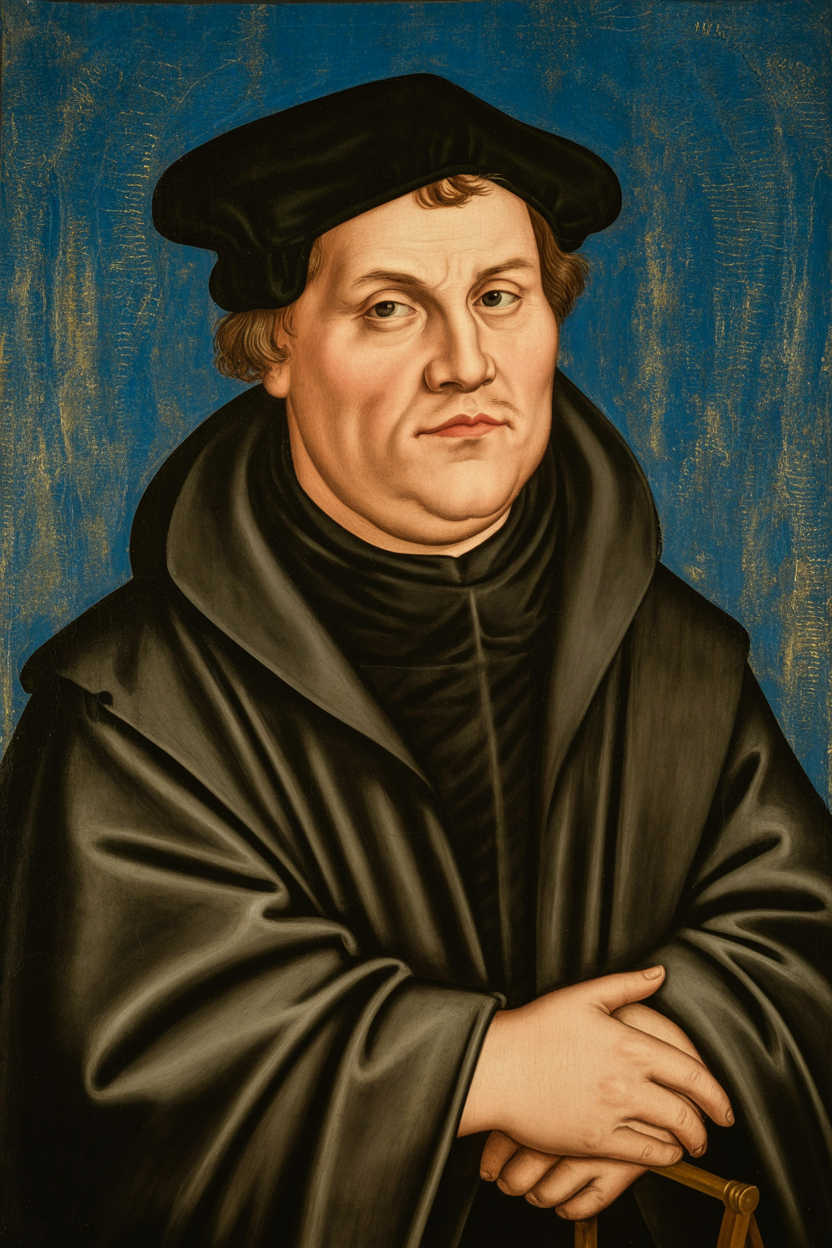
Martin Luther
Martin Luther was an Augustinian monk and professor of theology at the University of Wittenberg. His study of Romans led him to the doctrine of justification by faith alone (Sola Fide), which sparked the Protestant Reformation when he posted his 95 Theses on October 31, 1517. Luther challenged the Catholic Church's doctrines and practices, specifically the sale of indulgences. His 95 Theses aimed to reform—but not break away from—the Church. However, this led to his excommunication and the creation of new, independent Christian denominations. Luther translated the Bible into German, making Scripture accessible to common people.
Historical Context
The Protestant Reformation began in 1517 when German monk Martin Luther challenged the Catholic Church's doctrines and practices. Luther lived during a time when the Catholic Church held enormous political and spiritual power. The sale of indulgences—payments believed to reduce time in Purgatory—prompted Luther's initial protest. His discovery that salvation came through faith, not works or payments, revolutionized Christian theology and shook the foundations of medieval Christendom.
Faith Under Attack🛡️ RISKED LIFE
Persecution Faced
Luther was declared a heretic and outlaw by both Pope Leo X (Papal Bull "Exsurge Domine," 1520) and Emperor Charles V (Edict of Worms, 1521). Anyone could kill him without legal consequence. He was excommunicated from the Catholic Church and his writings were ordered to be burned.
⚔️ Suffering & Sacrifice
Luther was kidnapped by friends and hidden in Wartburg Castle for his own protection (1521-1522). He lived under constant threat of assassination. Though he died of natural causes in 1546, he spent 25 years as a hunted man, knowing that capture meant execution. His followers were massacred in the Peasants' War (1524-1525), and many early Lutherans were burned at the stake across Europe.
Key Teachings
- 1Salvation by grace through faith alone (Sola Fide)
- 2Scripture alone as the ultimate authority (Sola Scriptura)
- 3The priesthood of all believers
- 4Christ alone as mediator between God and man
Bible Texts Used in Protest
Romans 3:2
“Much every way: chiefly, because that unto them [the Jews] were committed the oracles of God.”
Explanation: Luther argued that the "oracles of God" were entrusted to the Jewish people, who never included the Apocrypha in their Hebrew canon. Therefore, these books could not be considered part of inspired Scripture.
2 Timothy 3:16
“All Scripture is given by inspiration of God, and is profitable for doctrine, for reproof, for correction, for instruction in righteousness.”
Explanation: Luther contended that the Apocrypha did not meet the standard of being "God-breathed" (theopneustos). He pointed to historical inaccuracies and theological inconsistencies as evidence these books lacked divine inspiration.
Romans 1:17
“For therein is the righteousness of God revealed from faith to faith: as it is written, The just shall live by faith.”
Explanation: This verse became the foundation of Luther's theology. He saw the Apocrypha's teaching on works-based salvation (Tobit 12:9) as directly contradicting this principle.
Apocryphal Teachings Contested
Tobit 12:9
“For alms doth deliver from death, and shall purge away all sin.”
Issue: Teaches salvation by charitable works, contradicting justification by faith alone.
2 Maccabees 12:44-45
“For if he had not hoped that they that were slain should have risen again, it had been superfluous and vain to pray for the dead.”
Issue: Used to justify Purgatory and prayers for the dead—doctrines Luther vehemently opposed.
Legacy
Luther's 1534 German Bible placed the Apocrypha in a separate section between the Old and New Testaments with a preface stating these books are "not held equal to the Holy Scriptures, but are useful and good to read." This approach influenced all subsequent Protestant Bibles.
Study this topic in depth →
Continue Your Study with Logos
Access the Logos Factbook for comprehensive research on the Apocrypha, including manuscripts, historical context, and scholarly analysis.