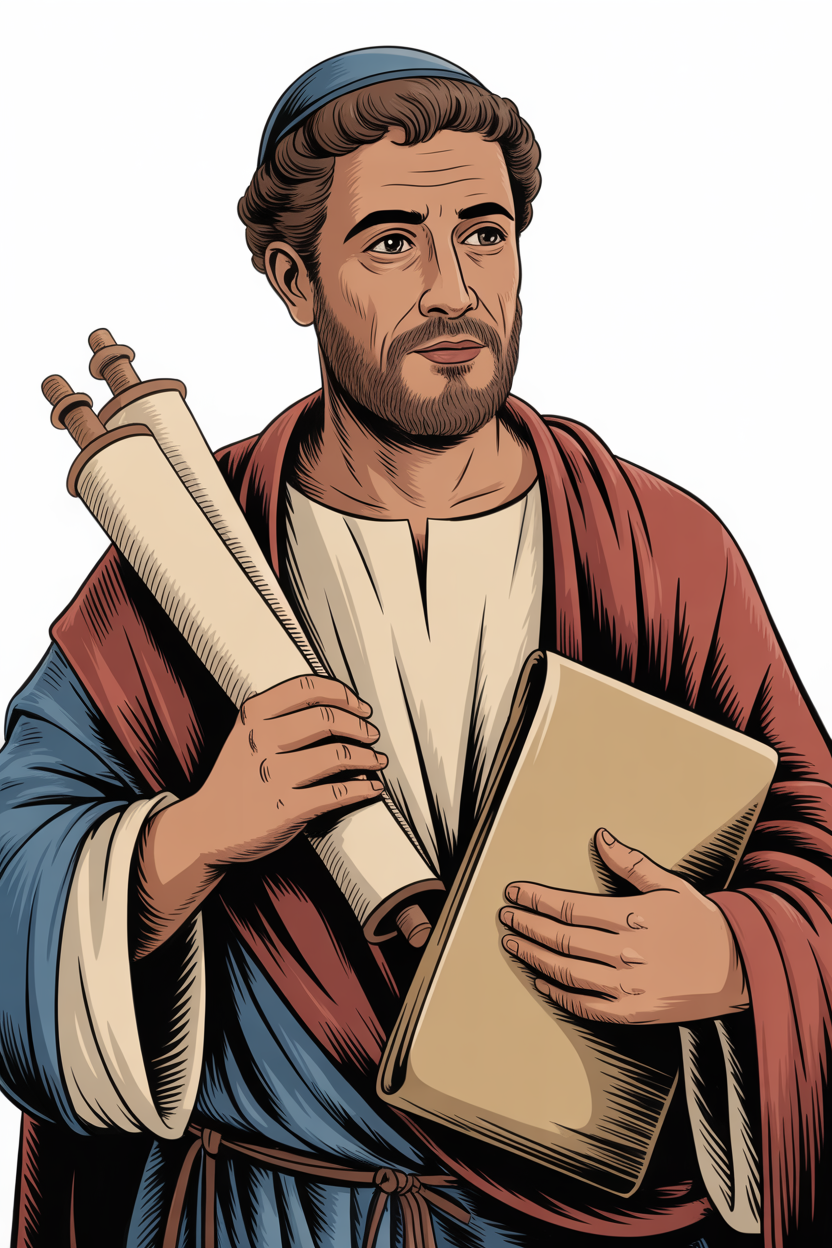
Author of 1 Maccabees
The author of 1 Maccabees is anonymous but was clearly a Jewish patriot living in Judea around 100 BCE. Unlike 2 Maccabees, this author writes in a straightforward historical style, modeling his work on the biblical books of Samuel and Kings.
Historical Context
1 Maccabees covers the period from 175-134 BCE, describing the Jewish revolt against the Seleucid Empire. The author was likely a supporter of the Hasmonean dynasty, writing to legitimize their rule over Judea.
Faith Under Attack
Persecution Faced
The author documented the systematic attempt to destroy Judaism. Antiochus IV banned all Jewish religious practices, burned Torah scrolls, killed anyone found with Scripture, and executed mothers who circumcised their sons. The Temple was turned into a shrine to Zeus.
⚔️ Suffering & Sacrifice
The author recorded a WAR FOR SURVIVAL. He documented how Mattathias started the revolt by killing a Jew who was about to offer pagan sacrifice, then fled to the mountains. He recorded the massacre of 1,000 Jews who refused to fight on the Sabbath. He documented the deaths of Judas Maccabeus (160 BCE), Jonathan (143 BCE), and Simon (134 BCE)—all the Maccabean heroes died violent deaths fighting for their faith. This was not ancient history to the author; it was his lived experience of a community that nearly perished for its beliefs.
Key Teachings
- 1Zeal for the Torah justifies armed resistance
- 2God works through human courage and military action
- 3The Hasmoneans are legitimate leaders of Israel
- 4Apostasy brings divine judgment
Bible Texts Referenced
1 Kings 18:40
“And Elijah said unto them, Take the prophets of Baal; let not one of them escape. And they took them: and Elijah brought them down to the brook Kishon, and slew them there.”
Explanation: The Maccabees' zeal echoes Elijah's slaughter of the prophets of Baal. Both acted violently to purify Israel from idolatry.
Numbers 25:11
“Phinehas, the son of Eleazar, the son of Aaron the priest, hath turned my wrath away from the children of Israel, while he was zealous for my sake among them.”
Explanation: 1 Maccabees explicitly compares Mattathias (father of Judas Maccabeus) to Phinehas, whose violent zeal stopped a plague.
Protestant Concerns
1 Maccabees 9:27
“So was there a great affliction in Israel, the like whereof was not since the time that a prophet was not seen among them.”
Issue: The book itself admits there were no prophets during this period. Protestants ask: How can Scripture be written when prophets are absent?
1 Maccabees 14:41
“The Jews and priests were well pleased that Simon should be their governor and high priest for ever, until there should arise a faithful prophet.”
Issue: Again acknowledges the absence of prophets, suggesting the author did not claim prophetic inspiration for his own work.
Legacy
1 Maccabees is our primary historical source for the Maccabean revolt and the origins of Hanukkah. While not canonical for Protestants, it is essential for understanding the 400 years between the Old and New Testaments and the political situation Jesus entered.
Study this topic in depth →
Continue Your Study with Logos
Access the Logos Factbook for comprehensive research on the Apocrypha, including manuscripts, historical context, and scholarly analysis.